

Article by Wayne Gillam, Photos by Ryan Hoover / UW ECE News

In new undergraduate capstone courses offered by UW ECE, students are working together in teams to learn how to design and build microchips for specific, real-world applications. Shown above, chips designed by student teams in the Department’s Integrated Systems Capstone course and VLSI Capstone course.
Microchips, also known as semiconductors, integrated circuits, or simply “chips” in engineering circles, are a marvel. These tiny chips may be small, but they punch far above their weight, functioning as the intelligent core of modern technology. Microchips use billions of microscopic transistors with nanometer dimensions to process information, sense the world around us, execute software instructions, provide a platform for communication, and store data. They power a vast array of technologies, ranging from the smartphone in your hand to artificial intelligence to global communication networks for airplanes and satellites.
During the COVID-19 pandemic, when supply chains around the world tightened, it became clear to the United States government how important microchips are to the economy and national security. This realization launched an ongoing effort to revitalize semiconductor design and manufacturing across the country. A crucial part of this initiative is workforce development — training the next generation of engineers who can design and build microchips.
UW ECE is helping to meet this important need in several different ways, including participating in programs aimed at semiconductor workforce development, such as UPWARDS for the Future, and by providing virtual reality training for students.
“I would like to emphasize that we are providing pathways for a student to graduate with a bachelor’s degree and pursue a viable career in integrated circuit design. Traditionally, this option was only available to those with master’s and doctoral degrees.”
— UW ECE Professor Chris Rudell
Now, in new undergraduate capstone courses taught by UW ECE professors Chris Rudell and Ang Li, students are working together in teams to learn how to design and build microchips for specific applications. In this rigorous curriculum, students not only design chips, but over the span of about a year, they have the opportunity to send their designs out for fabrication at an industrial foundry and follow up with testing to ensure their chips work in real-world settings.
“It is clear that the demand for chip designers has risen, particularly in the United States. This is a critical technology for defense applications, economic development, and high tech,” Rudell said. “Nationwide, we’re just not graduating enough students that have skills to do integrated circuit design. That’s the critical need our courses are helping to address.”
“These courses provide a realistic and comprehensive experience for students interested in the semiconductor design industry,” Li added. “We teach students valuable design skills as well as system understanding, testing, and post-silicon practices.”
A collaborative environment provides uncommon opportunities
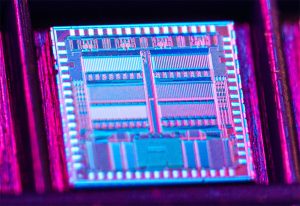
A closeup view of a chip designed by UW ECE doctoral student Elpida Karapepera and her student teammates in the 2025 spring quarter Integrated Systems Capstone course. This receiver chip significantly improves signal linearity and filters out strong interference. It is designed for advanced wireless communication applications, including Wi-Fi, Bluetooth, and software-defined radios. The chip design was described in a paper published at the 2026 IEEE International NEWCAS Conference. Karapepera, who now is a teaching assistant for the capstone course, received a Best Student Paper Award at the Conference for this work.
These courses got their start at UW ECE in 2025 and receive support from the Center for Education of Microchip Designers, or CEMiD, which is based at the University of California, Los Angeles (UCLA). CEMiD, led by professor Behzad Razavi at UCLA, works with other universities across the nation to train students to become microchip designers. Further support for Rudell and Li’s courses is provided by Apple, Advanced Micro Devices (AMD), Muse Semiconductor, and Taiwan Semiconductor Manufacturing Company (TSMC), the world’s largest dedicated semiconductor foundry.
As one of eight universities participating in CEMiD’s pilot program in 2025, UW ECE stands out as a pioneer in developing comprehensive chip tapeout courses like these for undergraduate and graduate students. The term “tapeout” comes from the early days of semiconductor design and fabrication, when the data file containing every detail of a chip’s physical definition was loaded onto a magnetic reel and shipped in the fastest way possible to a chip fabrication facility. Today, this same file that signifies the completed chip design is transferred over the internet. The tapeout is the final stage of the chip design process, when a completed and verified digital design is sent to a foundry to be manufactured into a silicon chip.
For undergraduate students at UW ECE, there are two main avenues for studying chip design. One is the Integrated Systems Pathway, which provides a sequence of courses that culminate in the Integrated Systems Capstone, the analog, mixed-signal, and radio frequency (RF) chip tapeout course taught by Rudell and other professors at UW ECE, depending on the academic year. The other is the Very Large-Scale Integrated (VLSI) / Digital Systems Design Pathway, which puts students on track to take the VLSI Capstone, the digital chip tapeout course taught by Li. The capstone courses are cross-listed, so graduate students and those from other UW schools and departments can also have this educational opportunity.

UW ECE Professor Chris Rudell (right) instructing students in the Integrated Systems Capstone course. This undergraduate capstone course teaches students how to design analog, mixed-signal, and radio frequency (RF) chips to an industry-level standard.
“As an undergraduate, there aren’t many opportunities to tape out a chip, let alone get the experience of designing a chip from start to finish,” said UW ECE alumnus Bryan Kim (BSECE ‘26), who took Rudell’s chip tapeout course during his senior year. “On top of that, by this point in the Pathway, the students who have stuck with it tend to be more motivated, which makes the group work more enjoyable.”
Students in both capstone courses can follow their designs through fabrication, which happens in the summer, and continues with testing and verification during the following academic year. Students who choose this option participate in a year-long experience that culminates in the design, fabrication, and testing of a functional microchip built for a specific application.
“I would like to emphasize that we are providing pathways for a student to graduate with a bachelor’s degree and pursue a viable career in integrated circuit design,” Rudell said. “Traditionally, this option was only available to those with master’s and doctoral degrees. The barrier to entry for a career in microchip design is quite high, but these courses shatter that obstacle for students by providing a real-world design experience.”
Advanced chip design, with real-world applications
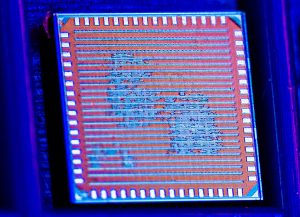
A closeup view of a chip designed by students in the VLSI Capstone course. This chip, titled “Bluetiful” by the student team that designed it, is a digital-only Bluetooth Low-Energy, or BLE, transmitter chip based on patented intellectual property from the lab of UW ECE Professor Matt Reynolds. The chip design was described in a paper published at IEEE RFID 2026, demonstrating UW ECE students working at a high level.
The learning experience extends well beyond the classroom. In the tapeout courses, student teams are encouraged to turn their own ideas into microchip designs, and they are provided with a robust set of resources to do so. In addition to guidance from the instructors and teaching assistants, engineers from Apple and AMD meet regularly with students to evaluate chip designs and offer feedback. Students are also offered the chance to collaborate with UW faculty members, developing microchips for research projects.
Students in the Integrated Systems Pathway have been advised by UW professors Robert Miyaoki, Hossein Naghavi, Sajjad Moazeni, and industry collaborators at Boeing, Amazon, and Texas Instruments. Students in the VLSI Digital Systems Design Pathway have also been advised by UW ECE professors.
“Last year, there were two student teams working with professor Matt Reynolds on Bluetooth transmitters,” Li said. “This year, we have two teams working with professor Yiyue Luo, building an AI accelerator for her intelligent textile glove. And we have yet another team collaborating with professor Lih-Yuan Lin on using micro-LED [light-emitting diodes] to do data transmission.”

UW ECE Assistant Professor Ang Li (standing, second from right) advises students in the VLSI Capstone course. This undergraduate capstone course teaches students how to design and build industry-standard digital microchips for modern technology.
As a result of this intellectual freedom, strong academic-industry partnership, and highly collaborative environment, many of the students’ chip designs are quite advanced. Some projects have even progressed beyond the classroom and into peer-reviewed publications and presentations at leading engineering conferences, such as the 2026 Institute of Electrical and Electronics Engineers (IEEE) International New Circuits and Systems (NEWCAS) Conference, the 2026 IEEE International Conference on Radio Frequency Identification (RFID 2026), and the 2026 IEEE Radio Frequency Integrated Circuits (RFIC) Symposium.
“Even after the course ended in Spring 2025, we continued testing the chip when it returned from fabrication to the Department in Autumn 2025,” said UW ECE alumna Kate Tseng (BSECE ‘26), who took Li’s chip tapeout course during her junior year. “Since the chip was successful, we were able to write a manuscript during the winter quarter and publish our paper at IEEE RFID 2026.”
“I’m excited to share that our work was accepted by the 2026 IEEE RFIC Symposium, proving that projects in this course reach a true professional publication standard,” said Zhuoran Wu (MSEE ‘26), an alumnus and incoming doctoral student who took Rudell’s chip tapeout course while completing his master’s degree. He added, “The most important thing this course taught me is how to make sure a design actually works when it is fabricated in silicon, not just on a computer screen.”
Looking ahead
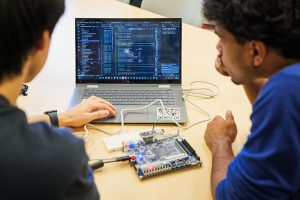
Students in the undergraduate VLSI Capstone course testing a field-programmable gate array (FPGA) prototype of their chip design before sending it out for fabrication.
Going forward, Rudell said that he anticipates these capstone courses will be taught by a core group of faculty in the Department who are experts in different aspects of chip design, rotating from year to year and offering students a range of expertise along with a variety of experiences. He and Li are also facilitating a passing down of knowledge between generations of students. For example, they ask students from prior years to provide a presentation on their course experience to students in the current year. And they are continually integrating feedback from students to improve course infrastructure.
Rudell and Li also said that they look forward to growing industry partnerships and support for these chip tapeout courses as they help to meet the demand for qualified microchip designers.
“We are producing competitive engineers at UW ECE,” Li said. “Only very few schools and universities offer this type of curriculum, and it’s not just because of the need for funding, it’s also because of the effort required. It takes more than a year to train a cohort of students, and we are doing that every year. The Department is dedicated to this continuous, non-stop effort because we all realize how important it is.”
“This course provides an excellent platform to learn about something that is so critical to economic development, national defense, and high-performance technology applications,” Rudell said. “For most companies, what they are seeking are college graduates that have been trained in this area and know how to leverage the most advanced CAD [Computer-Aided Design] tools to design a chip. That is exactly what we are providing.”
The future looks bright for those who want to build an academic foundation at the UW for a career in integrated circuit design. By the time they graduate, UW ECE students are doing far more than simply learning about semiconductor technology. They are designing, fabricating, and testing real microchips, gaining valuable experience that prepares them well for a career in the semiconductor industry.
The undergraduate Integrated Systems Capstone course is offered during winter and spring quarters at UW ECE, and the undergraduate VLSI Capstone course is offered in spring quarter. For more information, contact UW ECE professors Chris Rudell and Ang Li.