

Adapted from an article by Kristine White / Allen School
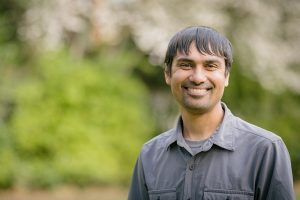
UW ECE and Allen School Professor Shwetak Patel was recently elected part of the 2026 class of the American Academy of Arts & Sciences. He joins the likes of Benjamin Franklin, Alexander Hamilton, Albert Einstein, Jennifer Doudna, Barack Obama and more. Photo by Ryan Hoover / UW ECE
The American Academy of Arts & Sciences, one of the nation’s most prestigious honor societies, has elected Shwetak Patel as part of its 2026 class of new members. Patel is the Washington Research Foundation Entrepreneurship Professor in UW ECE and the Paul G. Allen School of Computer Science & Engineering. Allen School director and professor Magdalena Balazinska was also elected to the AAA&S this year. Chartered in 1780, the Academy recognizes exceptional individuals across academia, industry, the arts and more who examine new ideas and address issues of importance to both the nation and the world.
Patel is known for thinking outside the box by bringing together research in human-computer interaction (HCI) with ubiquitous computing and sensor-enabled embedded systems to advance new health and sustainability innovations.
“I’m humbled and honored to be inducted to the AAA&S. To see highly applied computing research celebrated at this level is so rewarding. I hope this serves as a catalyst for others to embrace a broader, more practical perspective on what computing can achieve for society,” said Patel, who is also associate director for development and entrepreneurship in the Allen School.
Many people carry around a smartphone in their pocket, and Patel’s research focuses on leveraging the device’s combined sensing, data processing and communication abilities to expand health care access. Patel, who directs the Allen School’s UbiComp Lab, has pioneered the ability to extract clinical grade signals using these everyday sensing devices to help users continuously monitor their health — which is especially helpful to those in low-resource settings. For example, he and his team developed the app FeverPhone that turns smartphones into thermometers and a smartphone-based glucose and prediabetes screening tool called GlucoScreen.
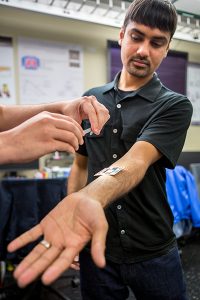
Patel has pioneered new ways of using the sensors built into smartphones for health screening, such as using the camera to gauge bilirubin levels.
To help commercialize some of these technologies, Patel founded the mobile health diagnostics company Senosis Health, which was acquired by Google and is now a core part of Google’s consumer health efforts. In addition to his UW faculty position, Patel is Distinguished Scientist and Head of Health Technologies at the company, which developed multiple apps that could screen for various health conditions. These include an app that uses a smartphone’s accelerometer to detect osteoporosis and another that analyzes selfies to screen for pancreatic cancer through changes in the scleral color of a user’s eye.
“To see highly applied computing research celebrated at this level is so rewarding. I hope this serves as a catalyst for others to embrace a broader, more practical perspective on what computing can achieve for society.”
— UW ECE and Allen School Professor Shwetak Patel
Another line of Patel’s research looks into using sensing technology to improve the health of the planet and tackle sustainability challenges. For example, he developed low-cost and easy-to-deploy sensor systems that could measure household energy consumption and help residents detect inefficiencies more effectively. Patel founded residential energy monitoring company Zensi, which was later acquired by Belkin, and he also co-founded the low-power wireless sensor platform company called SNUPI Technologies, which was acquired by Sears. More recently, he has helped reduce environmentally hazardous electronic waste by creating recyclable printed circuit boards and introduced AI models to help users better understand the environmental impact of everyday decisions.
“Shwetak’s work is deeply important, impactful, and incredibly creative,” said Jeff Dean (Ph.D., ‘96), chief scientist for Google DeepMind and Google Research. “He has an incredible record of research publication, entrepreneurship, and real-world impact. His health sensing research has been integrated into Google products used by more than one billion people. As a fellow American Academy of Arts & Sciences member, I am proud to see Shwetak’s induction.”
Patel’s election to the Academy is the latest in a string of accolades recognizing the wide-ranging impact of his work. He has also received a MacArthur Foundation “Genius” Award, Sloan Research Fellowship, Microsoft Research Faculty Fellowship, MIT Technology Review Innovators Under 35 Award, World Economic Forum Young Global Scientist Award, NSF CAREER Award, National Academy of Engineering Gilbreth Award and the Presidential Early Career Award for Scientists and Engineers (PECASE).
A Fellow of the ACM, Patel earned that organization’s ACM Prize in Computing for mid-career contributions to the field and was inducted into the SIGCHI Academy by the ACM Special Interest Group on Computer Human Interaction.
Read more about the members of the 2026 class of members in the AAA&S announcement and a related UW News story.